

In modern proteomics, the ability to accurately decode peptides and their chemical modifications is essential—but traditional approaches are often limited to what is already known. In this paper, researchers introduce RNovA, a next-generation deep learning model that redefines how peptide sequencing can be performed.
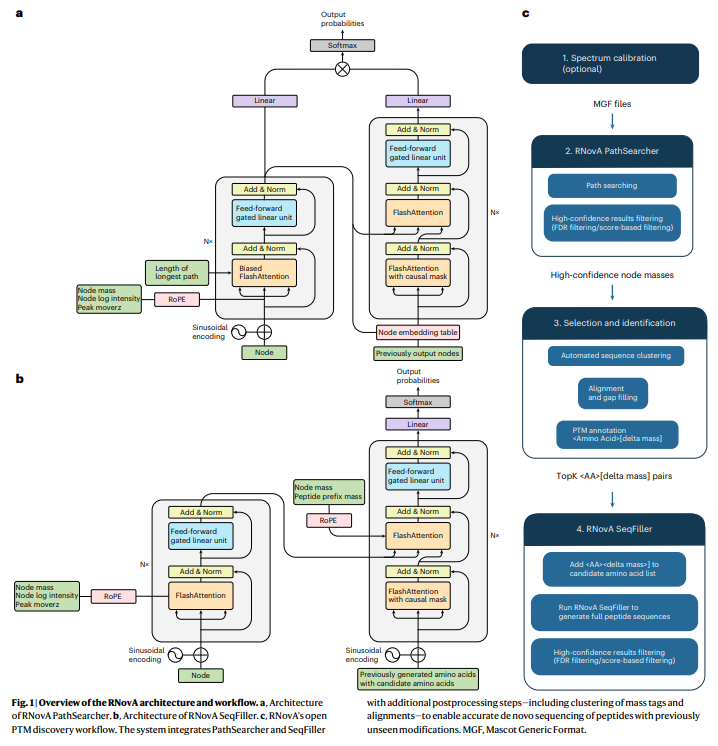
Built on a transformer architecture, RNovA enables de novo peptide sequencing directly from mass spectrometry data, without relying on protein databases. What sets it apart is its ability to discover post-translational modifications (PTMs) in a zero-shot setting—meaning it can identify unexpected or previously unseen modifications without prior training or predefined lists.
The model combines advanced positional encoding with a sequential decision-making process, allowing it to maintain state-of-the-art accuracy while dramatically expanding discovery potential. In practical applications, RNovA successfully identified rare and biologically significant modifications, including kynurenine in clinical samples, and uncovered previously unannotated modifications in organisms lacking reference proteomes.
At BSI, we are proud of our team who collaborated on this work, contributing to an innovation that pushes the boundaries of proteomics research. By opening the door to unbiased and scalable PTM discovery, RNovA represents a major step forward in proteomics—enabling researchers to explore previously hidden layers of biological complexity and accelerate insights across disease research, microbiology, and beyond.
Mao, Z., Peng, C., Chen, Y. et al. Zero-shot de novo peptide sequencing with open posttranslational modification discovery. Nat Biotechnol (2026). doi:10.1038/s41587-026-03116-1
Abstract
De novo peptide sequencing directly infers sequences from mass spectrometry data without relying on protein databases. Although recent deep learning models can also identify posttranslational modifications (PTMs), they require labeled training data for this task. Here we introduce rotary positional embedding-enhanced de novo sequencing algorithm (RNovA), a transformer-based de novo sequencing algorithm enhanced with relative positional embeddings and a reinforcement-learning-style sequential decision framework. RNovA enables open PTM discovery in a zero-shot setting—without retraining or a predefined list of candidate residues—while maintaining state-of-the-art performance on standard benchmarks. Demonstrating this capability, we successfully identified peptides modified by kynurenine—an uncommon and biologically relevant PTM—in clinical samples from patients with RA and validated this discovery with synthetically synthesized reference peptides. Furthermore, we demonstrated open de novo PTM discovery by analyzing the bacterial strain A1232E, which lacks a reference proteome, and detected an unannotated glutamic acid modification. RNovA enables exploration of previously inaccessible regions of the proteome, including peptides with unexpected or unannotated modifications.